Material Issues
*Updated on May 29, 2026
With the formulation of Casio's Basic Policies for 2030 and medium-term management plan, we have augmented existing material issues for corporate social responsibility (CSR) with additional issues aimed at achieving sustainable corporate growth. This has resulted in eight material issues organized into three groups: value creation through business, enhancement of management capital, and strengthening of management foundation.
Objective and process in identifying new material issues
In response to the release of the 4th edition of the Global Reporting Initiative (GRI) Guidelines, Casio identified in 2015 a series of material issues requiring its attention, and has been utilizing the PDCA cycle within sustainable management to make progress in these areas. Now, in an environment undergoing dramatic changes, Casio believes that the best course of action is to return to its tradition and essence of value creation as a foundation for generating innovation. To this end, Casio has redefined its material issues to be more in line with its management strategy, identifying new issues to better drive actionable initiatives.
These material issues are divided into three groups: value creation through business, enhancement of management capital, and strengthening of management foundation. Within value creation through business, we aim to create new innovations that meet and exceed consumer needs, in line with the core concept of our Basic Policies for 2030 Goal Achievement. Enhancement of management capital and strengthening of management foundation are designed to support achievement of value creation through business. With particular emphasis on three kinds of management capital—human capital, intellectual capital, and manufactured capital—we have selected issues under four themes to achieve strengthening of management foundation.
Material issues
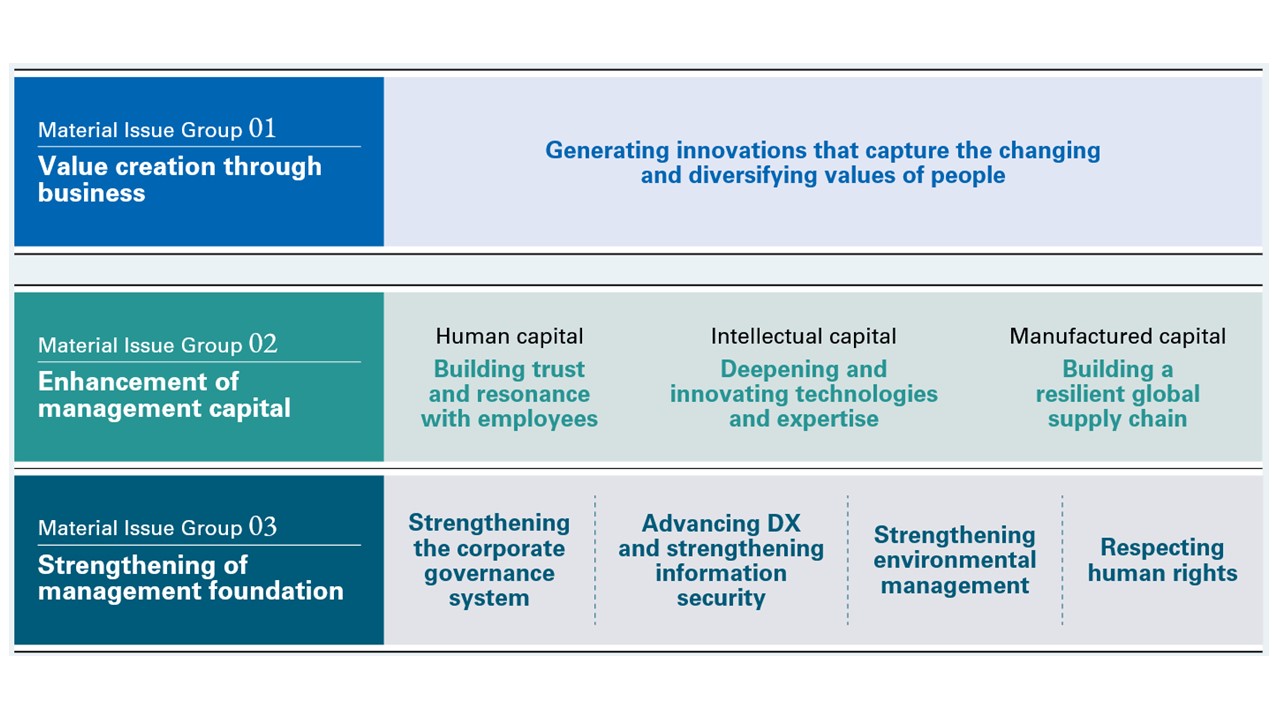
To identify its material issues, Casio first created an issue list using a political, economic, social, and technological (PEST) analysis of environmental changes and social conditions with importance for the Company. We then prepared a list of key environmental and social issues based on various guidelines, and identified risks and opportunities for each. Each issue was then evaluated for its importance level, taking into account the state of its countermeasures. Issues important to Casio and important with respect to the environment and society were integrated, forming three groups and our hypothetical material issue set. This hypothesis was then tested for validity in sessions with our top management and external experts, after which material issues were finalized by approval of the Board of Directors.
Identification process

Setting concrete goals and KPIs
Casio has set targets and KPIs for identified material issues since FYE 3/2025 and discloses the results of its performance review each year. In formulating our new Medium-Term Management Plan (FYE 3/2027 – FYE 3/2029), we have reviewed identified material issues.
As a result, areas of focus and main activities for each material issue, as well as associated targets and KPIs, have been revised.
These targets and KPIs were discussed and determined by the Sustainability Committee and reported to the Board of Directors.
Material Issue Group 01: Value creation through business
| Material issue Generating innovations that capture the changing and diversifying values of people | Outline goal Continue to address social issues through business model reform in line with social changes to create new value focuses | |||
|---|---|---|---|---|
| Core business | Focus area | Main activities | FYE 3/2027 and FYE 3/2029 targets | FYE 3/2031 targets |
| Timepieces | ● Providing products and services to realize diverse lifestyles | ● Providing products and experiences that pursue the distinctive qualities of the CASIO WATCH and G-SHOCK brands and deliver wonder and inspiration that exceed user expectations | ● Facilitate ethical lifestyle by developing environment-friendly products: Achieve 80% or higher rate of products using environment-friendly materials, such as bio-based resin, for new G-SHOCK models (resin) ● Offer high-quality, affordably priced models to provide a wide range of users with products that are easy to use and can be enjoyed over the long term | ● Achieve 90% or higher rate of products using environment-friendly materials, such as bio-based resin, for new product models (resin) ● Offer timepieces that allow users to express their own personal style |
| Education | ● Providing the best-in-class educational tools along with hands-on educational support | ● Providing tools and teaching methods that contribute to improving the quality of education in emerging economies | ● Provide optimal tools tailored to the educational environment of individual countries: Achieve growth rate for scientific calculator sales in emerging economies of 20% higher than FYE 3/2026 ● Conduct teacher training and other initiatives to promote effective use of scientific calculators in emerging economies | ● Provide products, services, and teaching materials that boost learner curiosity |
| ● Providing products and services that use ICT to improve learning efficiency | ● Supporting learning environments through digitalization | ● Create new business area related to learning | ||
| Sound | ● Creating new sound experiences to bring joy to people’s lives | ● Researching and developing products/services for music enjoyment targeting hobbyists and casual users | ● Create new experiential value by linking products with apps that leverage new technologies | ● Provide products and services that offer new experiences related to sound |
| New businesses | ● Providing value that contributes to the well-being of every individual around the world | ● Providing products and services in the personal well-being domain | ● Expand settings for applications of Moflin smart companion ● Continuously provide new products and services | ● Expand business built around products that support well-being (such as Moflin) |
Material Issue Group 02: Enhancement of management capital
Human capital
| Material issue Building trust and resonance with employees | Outline goal Develop human resources who think and act on their own initiative and foster a culture where all employees are motivated to perform | ||
|---|---|---|---|
| Focus area | Main activities | FYE 3/2027 and FYE 3/2029 targets | FYE 3/2031 targets |
| Developing autonomous human resources | ● Strategy for continued implementation of career training program ● Ongoing implementation of “job challenge” internal transfer program | ● Percentage of regular employees covered by career training program: 84% ● Cumulative number of “job challenge” internal transfer program participants: 210 | ● 100% ● 250人 |
| Strengthening management | ● Cultivating executive candidates ● Promoting diversity and inclusion ● Ongoing unconscious bias training | ● Number of participants in future executive candidate cultivation program: 35 ● Number of participants in future female manager candidate cultivation program: 65 ● Percentage of female managers: 8.5% ● Regular employee gender wage disparity: 83% | ● 50 ● 90 ● 10% ● 85% |
| Promoting health and productivity management | ● Measures to maintain White 500 certification ● Range of measures to promote health and productivity management | ● Maintain White 500 certification ● Take-up rate of childcare leave and annual leave among male employees: 100% ● Health check follow-up implementation rate: 94% | ● Maintain White 500 certification ● 100% ● 100% |
Intellectual capital
| Material issue Deepening and innovating technologies and expertise | Outline goal Continue contribution to enriched lifestyles and development of a sustainable society by providing services and products backed by technology that benefit people and society | ||
|---|---|---|---|
| Focus area | Main activities | FYE 3/2027 and FYE 3/2029 targets | FYE 3/2031 targets |
| Linking tangible and intangible value for ongoing development of new business opportunities | ● Energizing open innovation ● Developing business-development human resources | ● Forge strategic alliances (business / technology) with other companies ● Create new value by utilizing developed human resources | ● Understand human and societal needs and build an ecosystem that links tangible and intangible value alongside technology development |
| Creating new value through integrated development from components/materials to products and services and technology evolution | ● Promoting the development of technologies that utilize AI ● Developing new technology components | ● Provide AI services that support individual self-realization ● Business contribution of sales of products incorporating new technology components: Timepieces 15% / Education 5% / Sound 10% or more | |
| Developing environment-friendly technology | ● Promoting adoption of environment-friendly materials and transition to environment-friendly design | ● Reduce virgin plastic use in compact products and expand use of next-generation materials Products: at least -13% Packaging: at least -70% (vs. FYE 3/2021) | |
Manufactured capital
| Material issue Building a resilient global supply chain | Outline goal Build a sustainable supply chain responsive to business risk and social responsibility | ||
|---|---|---|---|
| Focus area | Main activities | FYE 3/2027 and FYE 3/2029 targets | FYE 3/2031 targets |
| Strengthening the business continuity system throughout the supply chain | ● Establishing structure for business continuity plan (BCP) for production operations in the event of a disaster or geopolitical risk | ● Address BCP issues in coordination with management priority issues (China risk and priority areas of portfolio) | |
| Realizing a responsible supply chain | ● Monitoring and improving the supply chain in terms of respect for human rights and environmental protection ● Providing corporate social responsibility (CSR) training to business partners to build sustainable partnerships | ||
| ● Achieve 100% CSR survey implementation rate for primary suppliers and establish cycle of improvement ● On-site audit implementation rate at key business partners: 100% ● Conduct CSR training once a year | |||
Material Issue Group 03: Strengthening of management foundation
| Material issue Strengthening corporate governance system | Outline goal ・Gain genuine public trust by firmly embedding a sound corporate culture with high levels of integrity ・Achieve sustainable improvement in corporate value through appropriate and efficient business operations | ||
|---|---|---|---|
| Focus area | Main activities | FYE 3/2027 and FYE 3/2029 targets | FYE 3/2031 targets |
| Instilling integrity awareness and maintaining and improving compliance awareness | ● Establishing and instilling integrity throughout the organization ● Strengthening compliance as a foundation for growth | ● Implementation rate of training to raise awareness of the Casio Business Conduct Guidelines: 100% ● Zero serious compliance violations | ● Continue to be a company trusted by the public based on sound corporate activities |
| Improving effectiveness of the Board of Directors as well as upgrading, expanding, and improving internal control | ● Improving the effectiveness of the Board of Directors | ● Conduct effectiveness evaluations of the Board of Directors, identify issues based on results, and formulate and implement improvement measures | ● Achieve sustainable improvement of corporate value based on highly effective supervision of management combined with ensuring of appropriate and efficient business execution |
| Strengthening global risk management | ● Risk response by each division and group company, along with regular checks of the global risk management system by the Internal Control Committee | ● Globally monitor risk response status by the Internal Control Committee (held twice a year), with follow-up actions based on effectiveness | ● Achieve sustainable corporate value enhancement based on identification of various risks in the business environment and rigorous risk management of Casio |
| Material issue Advancing DX and strengthening information security | Outline goal Establish data-driven value creation that realizes Casio Purpose and establish robust digital foundation that underpins trust | ||
|---|---|---|---|
| Focus area | Main activities | FYE 3/2027 and FYE 3/2029 targets | FYE 3/2031 targets |
| Advancing and streamlining business activities | ● One-to-one value creation built on customer data ● Advancing operations through use of AI ● Implementing data-driven management | Direct e-commerce ● E-commerce sales in countries where global common platform has been introduced: 115% vs. FYE 3/2026 ● Rate of increase in D2C traffic vs. FYE 3/2026: 170% Rate of efficiency improvement through use of AI*: 50% or more vs. FYE 3/2026 Incorporate data analysis into decision-making and begin operational use for key management themes *Non-consolidated target | ● Establish user-centered value chain and deliver new customer experiences |
| Developing DX human resources and strengthening execution capability | ● Raising baseline level of digital/AI literacy ● Cultivating human resources capable of driving DX | ● Participation rate in basic digital/AI education*: 100% | ● Achieve digital/AI proficiency among all employees |
| Strengthening information security capabilities that support business continuity | ● Security measures and improvement ● Boosting level of automated detection and automated response ● Further improving resilience capabilities | ● Implement security improvement measures based on evaluations by external agencies: once a year | ● Globally visualize all information assets and control risks |
| Material issue Strengthening environmental management | Outline goal Drive efforts to reduce environmental impact across the range of business activities with the aim of realizing a healthy and sustainable global society for the future | ||
|---|---|---|---|
| Focus area | Main activities | FYE 3/2027 and FYE 3/2029 targets | FYE 3/2031 targets |
| Responding to climate change | ● Reducing greenhouse gas emissions Groupwide | ● (Scope 1 and 2) Reduction of 32% or more vs. FYE 3/2019 ● (Scope 3) Reduction of 25% or more vs. FYE 3/2019 | ● (Scope 1 and 2) Reduction of 38% vs. FYE 3/2019 |
| Supporting a recycling society | ● Reducing waste emissions from products and business activities | ● Casio Green Star Products: 90% or more of sales | ● Realize business activities with inbuilt design that suppresses waste emissions by standardizing a range of initiatives for waste emissions reduction |
| Living in harmony with nature | ● Providing opportunities to learn about biodiversity with view to creating business opportunities | ● Cumulative number of participants in nature activities in Japan: 450 | ● Promote a deeper understanding and awareness of biodiversity among employees |
| Material issue Respecting human rights | Outline goal Put in place rigorous initiatives based on international human rights standards | ||
|---|---|---|---|
| Focus area | Main activities | FYE 3/2027 and FYE 3/2029 targets | FYE 3/2031 targets |
| Minimizing human rights risk and fostering a corporate culture that respects human rights | ● Continuing implementation of human rights due diligence ● Continuing implementation of human rights education | ● Conduct human rights risk assessments and provide improvement support for remediation (All Group sales and production companies / every two years) ● Conduct human rights education for employees once a year or more | ● Reduce human rights risk by strengthening human rights due diligence at all Group company bases in Japan and overseas ● Instill in the organization a mindset of respect for human rights so that human rights violations are not tolerated or tacitly accepted and a culture that excludes violations is nurtured |
Click here for FYE 3/2025 and FYE 3/2026 main activities and targets.
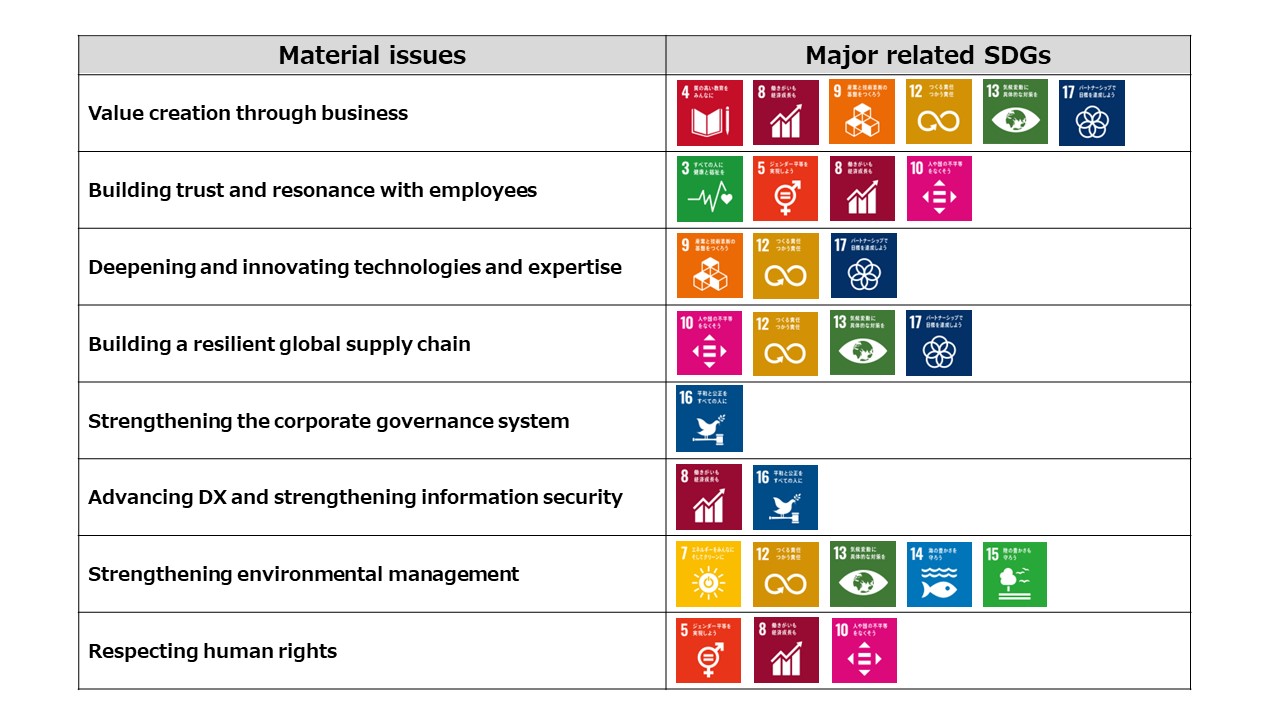
Material Issues and SDGs
Initiatives for each material issue contribute to the achievement of the Sustainable Development Goals (SDGs), and we will proactively advance each with the aim of resolving issues and providing this contribution.