Environmental Management
Vision and Basic Policies on the Environment
In 2012, Casio established the Casio Environmental Vision 2050, a long-term environmental management policy that looks ahead to the year 2050, and began working to fulfill it. Then, in 2021, Casio undertook a complete review of the policy to ensure that it remained relevant to the rapidly changing environment, and restructured the Casio Group Environmental Principles, which comprise the following elements.
- Casio Group Environmental Vision
- Casio Group Basic Policies on the Environment
- Casio Group Environmental Action Guidelines
Most recently, in 2026, in order to further strengthen its environmental management, Casio revised the Casio Group Environmental Principles, placing at its core the Casio Purpose, “Through the power to put wonder at hand, bring new levels of joy to lives one by one.”
The Casio Group Environmental Principles unify all of the elements of the Group’s environmental commitment — from the Casio Group Environmental Vision at the top, down to the Casio Group Basic Policies on the Environment and the Casio Group Environmental Action Guidelines. The Principles also ensure that long-term policies and short-term initiatives are integrated and consistent, thereby enhancing the effectiveness of environmental management.
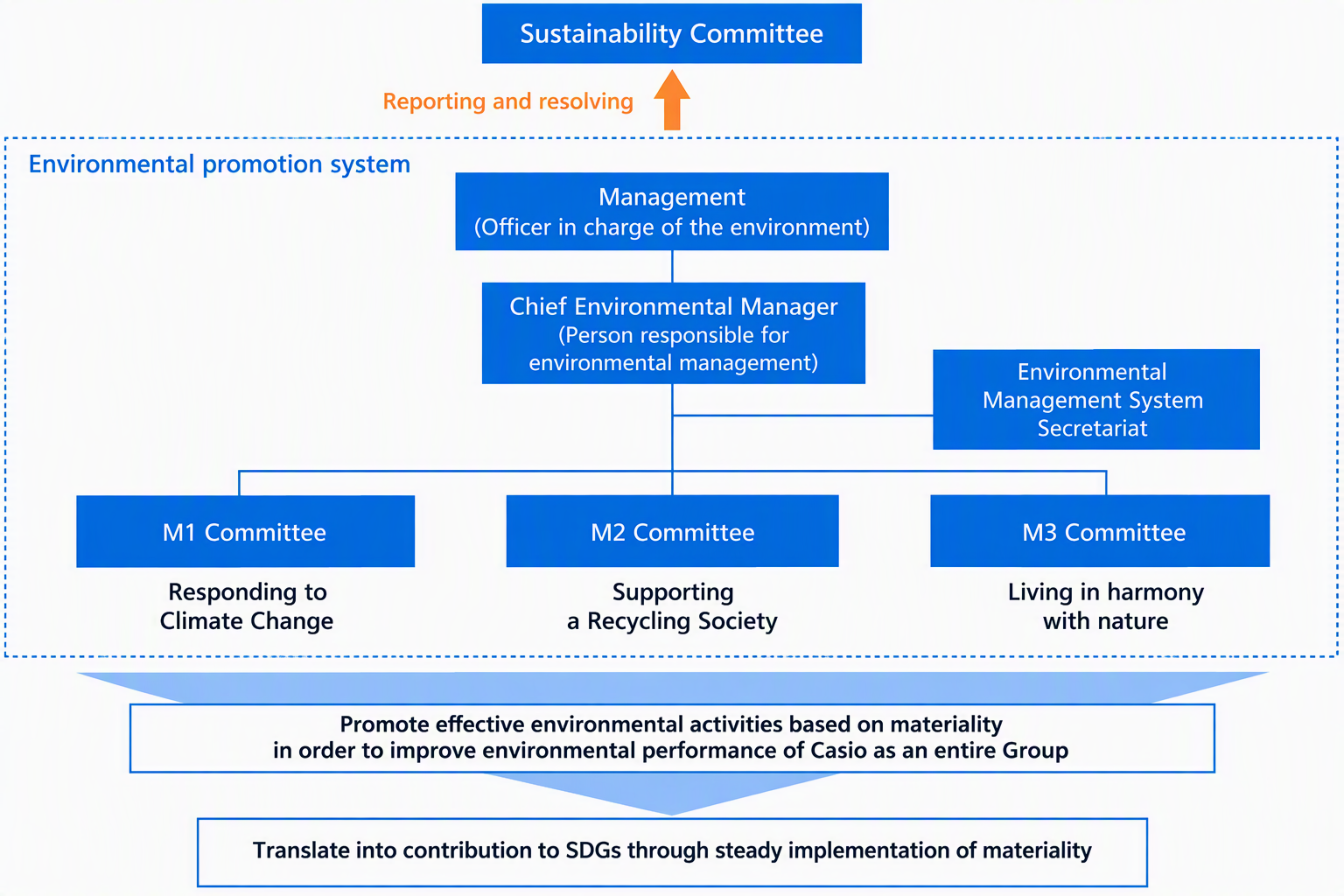
Positioned just below the Vision, the Casio Group Basic Policies on the Environment establish long-term approaches for addressing the focus areas under the environment-related material issue. These focus areas are: “Responding to Climate Change,” “Supporting a Recycling Society,” and “Living in Harmony with Nature.” Next, the Casio Group Environmental Action Guidelines establish a course of action for each value chain from a product life-cycle perspective.
Casio Group Environmental Principles
| Casio Group Environmental Vision | Guided by its Purpose “Through the power to put wonder at hand, bring new levels of joy to lives one by one,” Casio recognizes that a healthy global environment is the foundation of all economic activity. Accordingly, Casio is striving to reduce environmental impact across its business activities and to work in harmony with nature to help build a resilient, sustainable world for future generations to enjoy. |
| Casio Group Basic Policies on the Environment | To achieve the Casio Group Environmental Vision, Casio has identified the following three focus areas under the material issue of “Strengthening Environmental Management” and is taking a proactive and defined long-term approach to each area. |
| Casio Group Environmental Action Guidelines | Based on the Casio Group Basic Policies on the Environment, Casio has categorized business activities into seven product life-cycle stages and established a specific course of action to guide efforts at each stage. Seven stages and courses of action 1. Planning/Development: Leverage design to reduce environmental impact and develop products/services utilizing environmentally friendly technologies and materials (to offer environmental value) 2. Procurement: Collaborate with suppliers to reduce environmental impact when procuring parts and raw materials 3. Manufacturing: Minimize environmental impact of Group sites and the entire supply chain 4. Distribution: Reduce environmental impact by cutting greenhouse gas emissions from product delivery, etc. 5. Marketing/Sales: Reduce environmental impact by marketing for environmental value and using online marketing 6. Product Use/Services: Reduce environmental impact from product use and after-sales services 7. Collection/Recycling: Maximize collection/recycling of used products and packaging |
Implementation System
In 2016, Casio started to integrate its environmental management system into a group-wide system. First, the ISO 14001 certifications for the main sites of Casio Computer Co., Ltd.—the headquarters, and the Hamura R&D Center—were integrated under ISO 14001:2015 certification in 2017. In addition, the company established committees to handle its two areas of material environmental goals and, as necessary, set up working groups underneath them in which committee members participate and engage in activities related to their respective areas. The system was changed to a materiality-based, top-down structure rather than the previous structure, which was based on individual departments and bottom-up. Casio will continue to manage environmental activities effectively as an entire Group using ISO 14001.
List of ISO 14001 Certified Sites
| Certified and registered site | Date acquired | Remarks | |
|---|---|---|---|
| Casio Computer Co., Ltd. | Headquarters (including seven sales sites) | Dec-2000 | In April 2017, Casio integrated ISO 14001 certifications for these 2 sites |
| Hamura R&D Center | Oct-2000 | ||
| Yamagata Casio Co., Ltd. | Headquarters | Nov-1997 | |
| Casio Business Service Co., Ltd. | Headquarters | Jan-2000 | |
| Casio Computer (Hong Kong) Ltd. | Nov-2020 | ||
| Casio (Thailand) Co., Ltd. | Jul-2012 | ||
| Casio Taiwan Co., Ltd. | Oct-2007 | ||
| Casio Electronics (Shenzhen) Co., Ltd. | Feb-2002 | ||
| Casio Electronic Technology (Zhongshan) Co., Ltd. | Oct-2006 | ||
| Casio Electronics (Shaoguan) Co., LTD. | Jan-2018 | ||
| Casio Timepiece (Dongguan) Co., Ltd. | Sep-2019 | ||
* The percentage of Group employees at sites with ISO certification has reached 76%.
Environmental Education
Casio provides employees with environmental education in order to promote environmental activities smoothly. In addition to general education to raise awareness and promote understanding of the environment, each committee and working group identifies the competencies required for each activity at the beginning of the fiscal year and provides specific education in accordance with an annual plan for those who need to upgrade their competency following an evaluation of the competency of each committee member.