Product Initiatives
Product Initiatives
Approach and Policy
Casio pursues product development with consideration for environmental impact reduction throughout the product lifecycle, from the product development and design stage, to use by customers, to disposal and recycling after use.
Casio began its own environmental assessment program in 1993, commencing initiatives to assess the environmental impact of new products. Casio certifies those that met certain standards as Casio Green Products, and develops environmentally friendly products.
In 2009, Casio began to certify Casio Green Star Products under more rigorous assessment standards. In 2016, Casio introduced Casio Super Green Star Products under the highest assessment standards. Since then, Casio has continued to develop products that contribute to environmental impact reduction.
Product environmental assessment items | |
|---|---|
| 1. Promotes recycling | 7. Recyclability of batteries |
| 2. Designed for recycling | 8. Recycling label on batteries |
| 3. Components of products can be separated, disassembled | 9. Regulatory compliance |
| 4. Improved recycling | 10. Components of packaging can be separated, disassembled |
| 5. Improved energy efficiency | 11. Regulated use of packaging materials |
| 6. Regulated use of chemical substances | 12. Preserves the natural environment |
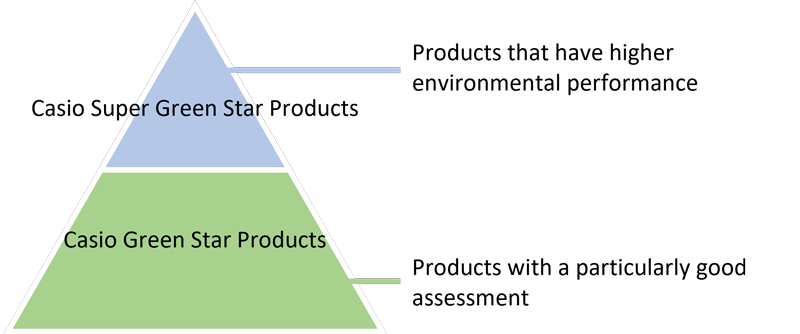
Casio also pursues a range of environmental initiatives for individual products, covering materials, packaging, energy efficiency in use, and more. In doing so, Casio seeks to help build a recycling-oriented society.
Models Certified as Casio Green Star Products and Casio Super Green Star Products
Some of the certified products (product series) are featured here.
Click here for detailed criteria.
Casio Super Green Star Products
FY2026
Watch: PRO TREK
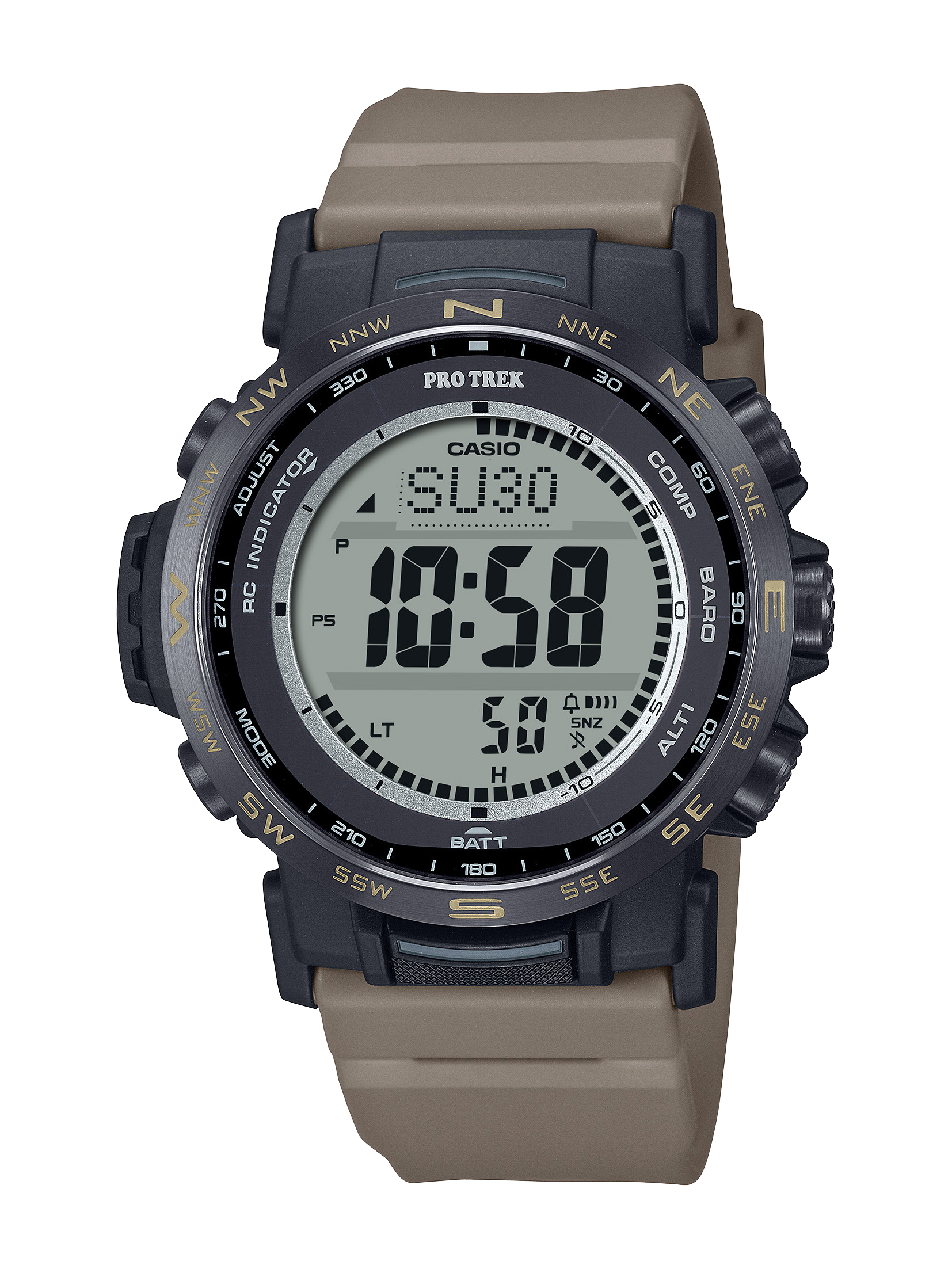
Environmental features
- Contains at least 80% biomass plastics (by total weight of plastics)
- Solar-powered
Targets and Performance
Casio has set a target for Casio Green Star Products and Casio Super Green Star Products to account for 90% of sales by fiscal 2026.
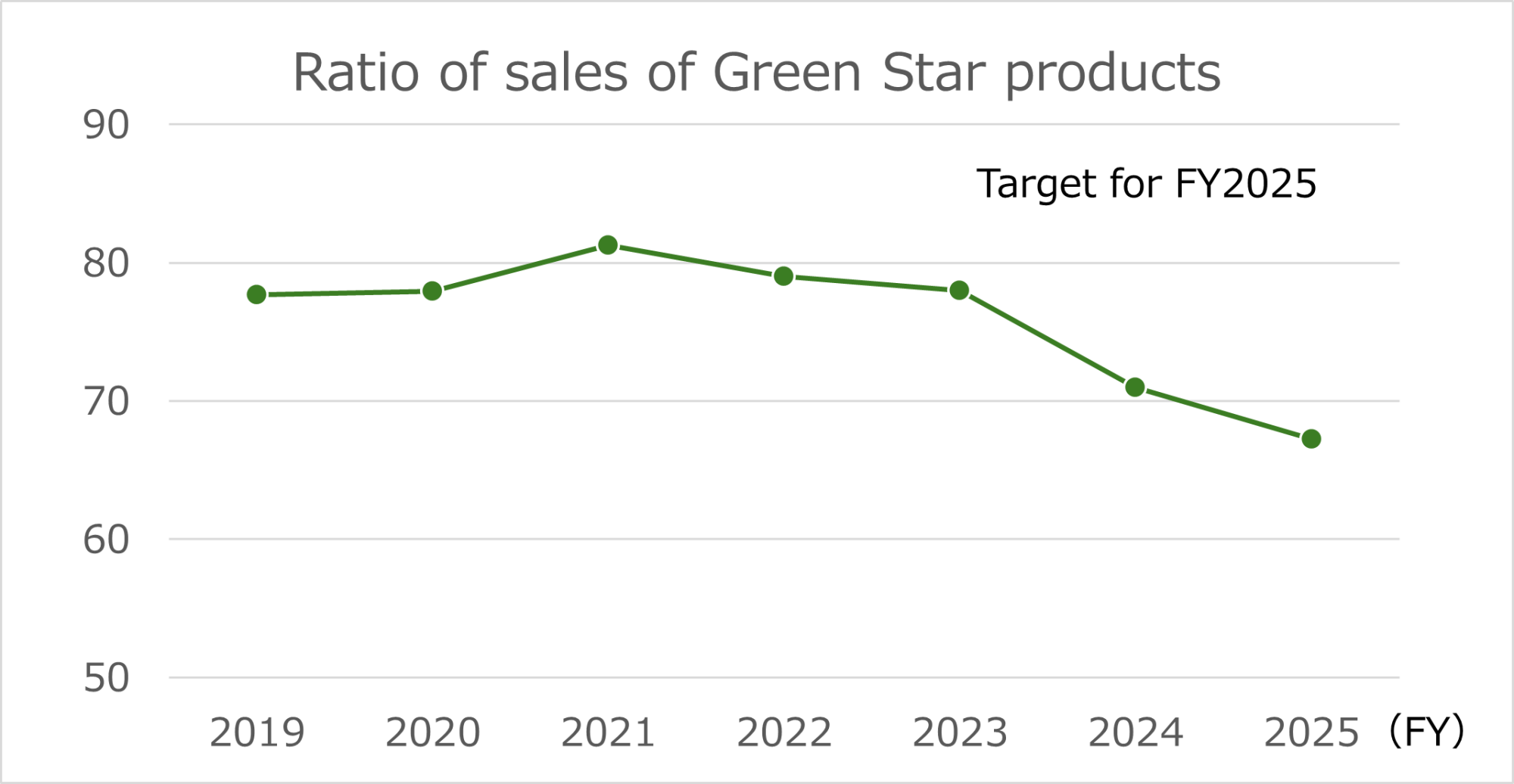
In fiscal 2026, the annual target was not met. This was due to changes in the business portfolio, given that Green Star Products’ share of sales varies by business. These changes included ending new development of electronic dictionaries, a category that accounted for a large share of Green Star Products, ending sales of electronic cash registers, and suspending new development and sales of handheld terminals.
Initiatives in Product Materials
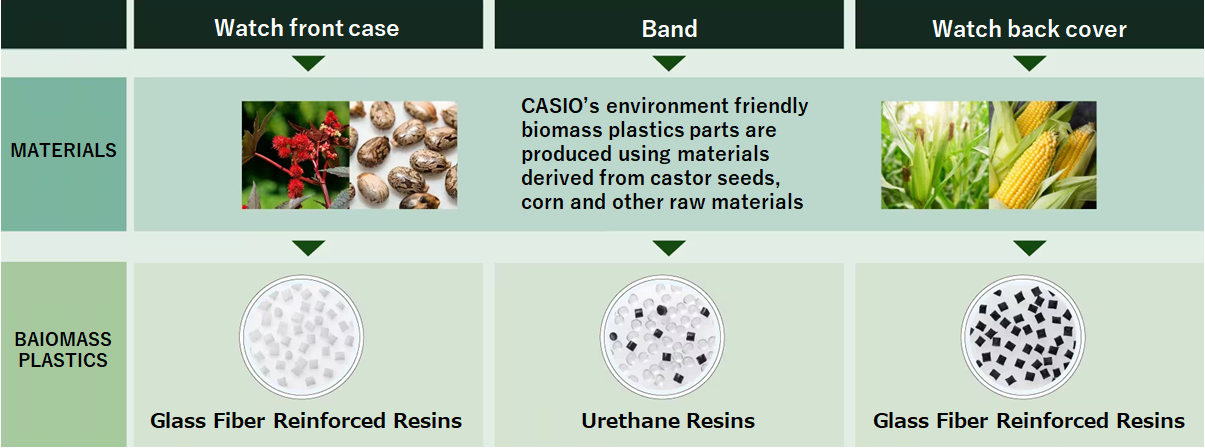
PRO TREK/G-SHOCK using environment friendly biomass plastic
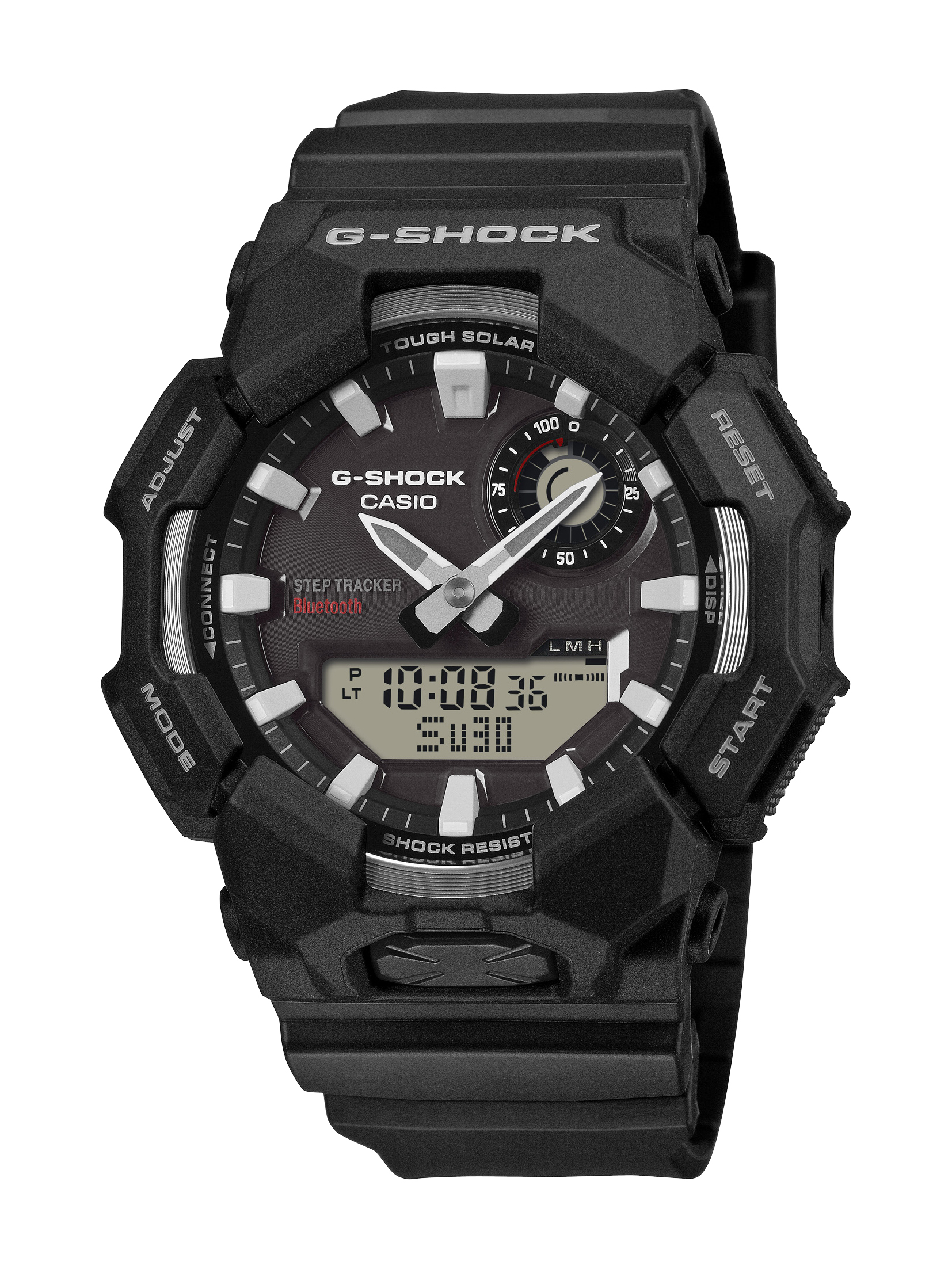
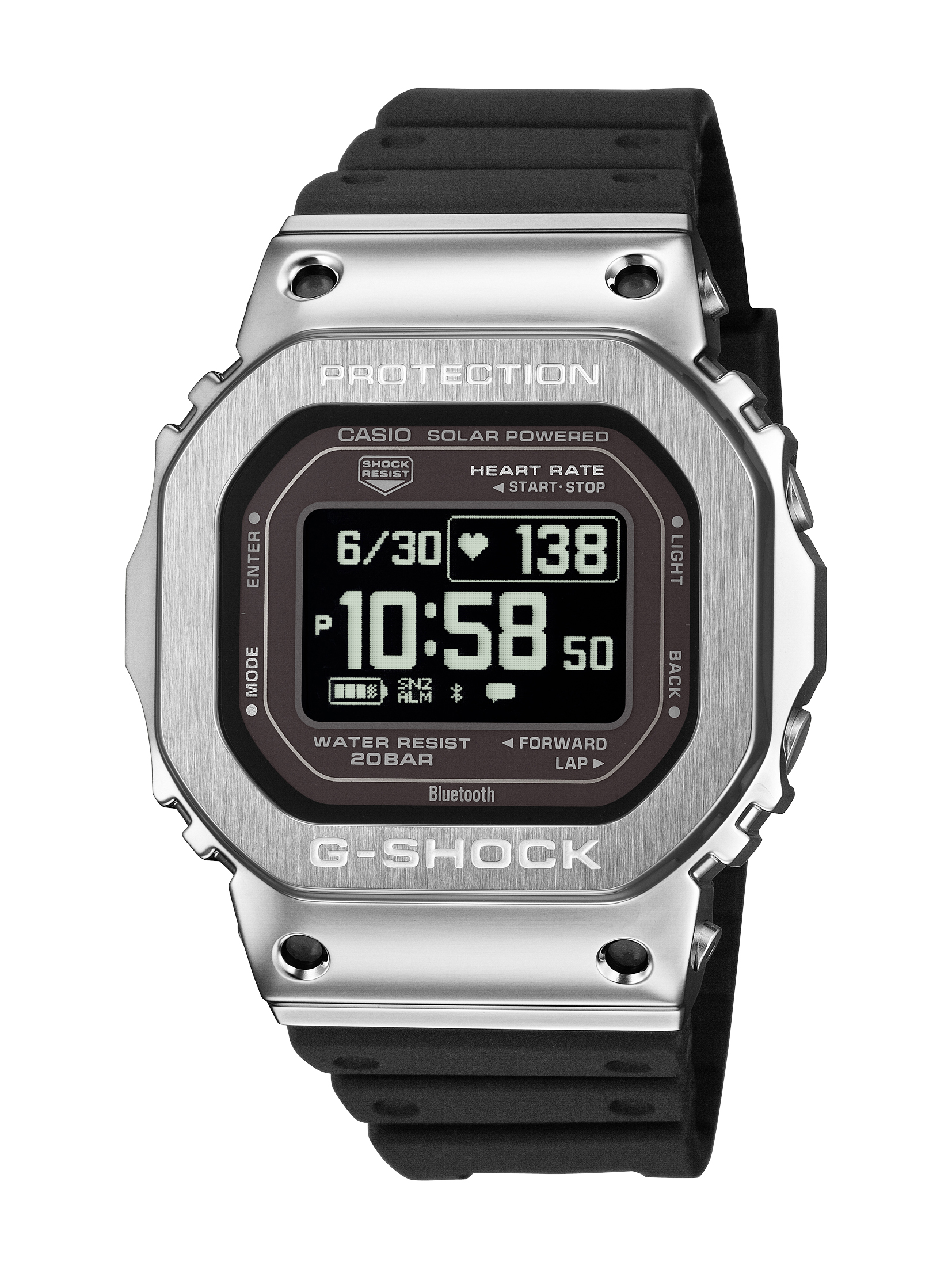
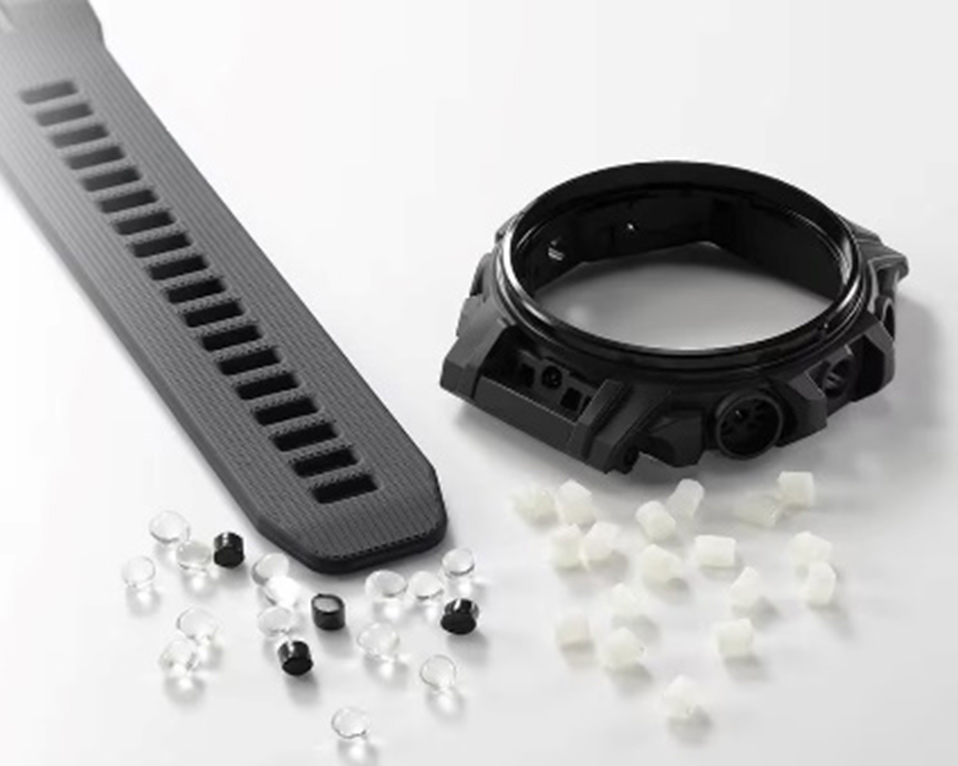
Since 2022, Casio has offered PRO TREK and G-SHOCK models with cases, bands, and back covers made of biomass plastics derived from castor seeds or corn.
Initiatives in Product Packaging
Initiatives in Calculator Product Packaging
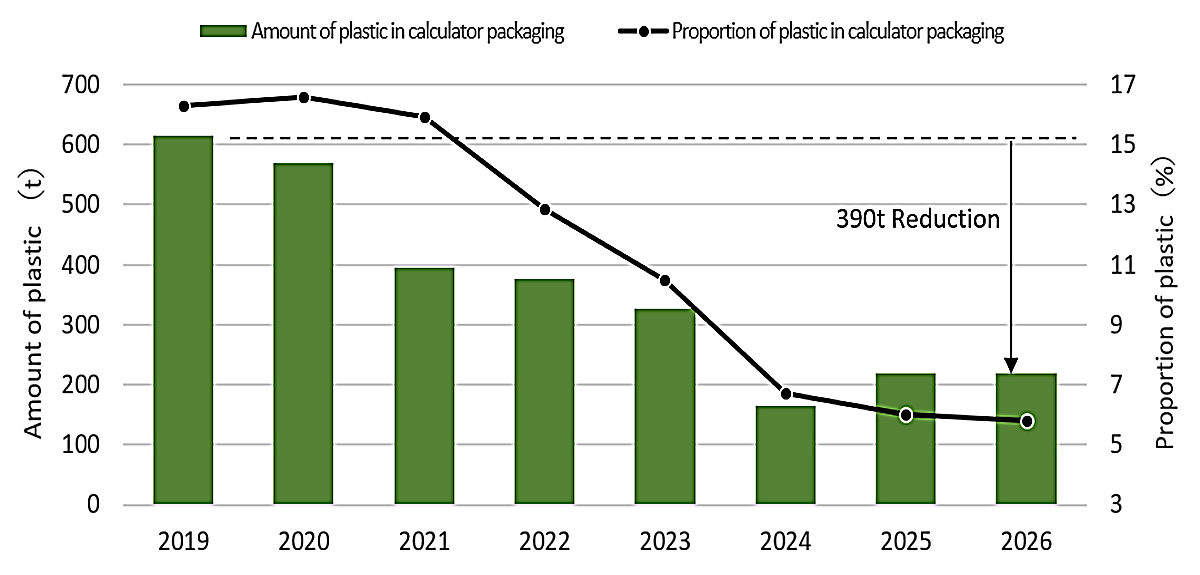
Casio is reducing the use of plastic by introducing paper packaging in calculator products line.
For paper packaging, Casio uses a large picture of the product and prints the product name and category in large lettering so that users will avoid misidentifying it when purchasing. Casio has also given consideration to efficiency of transport by making the packaging more compact.
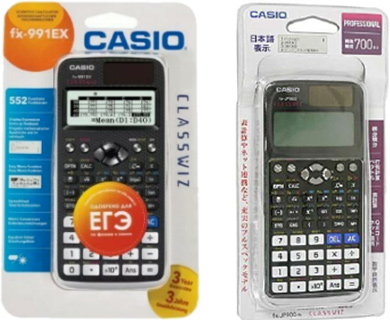
Previous package
Transparent plastic package showing the product

New package
Paper package with picture faithfully reproducing the product design
Paper packaging, first introduced in emerging markets, was rolled out in Europe in 2020 and later expanded to North America, China, and Japan. Calculations based on calculator shipment volumes show that the plastic used in packaging in fiscal 2026 was approximately 390 tons less than in fiscal 2019.
Initiatives in Watch Product Packaging
For watch products, Casio is switching to environmentally friendly packaging, category by category. By using recycled paper and recycled plastic as the main materials, Casio promotes efficient resource use while reducing its environmental impact. Click here for details and product information.
Initiatives in Casio Collection (General Watches)
In 2021 Casio adopted packaging that uses recycled paper as a raw material and decreased the amount of plastic used by 82% compared to conventional packaging (used by Casio).
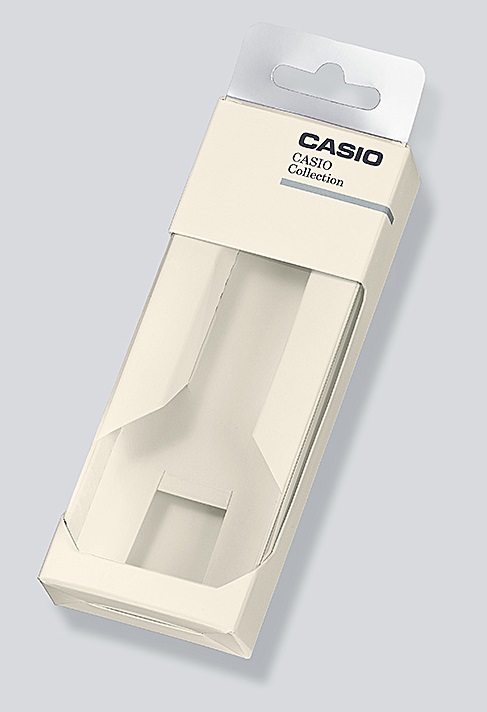
Paper packaging
Initiatives in PRO TREK series
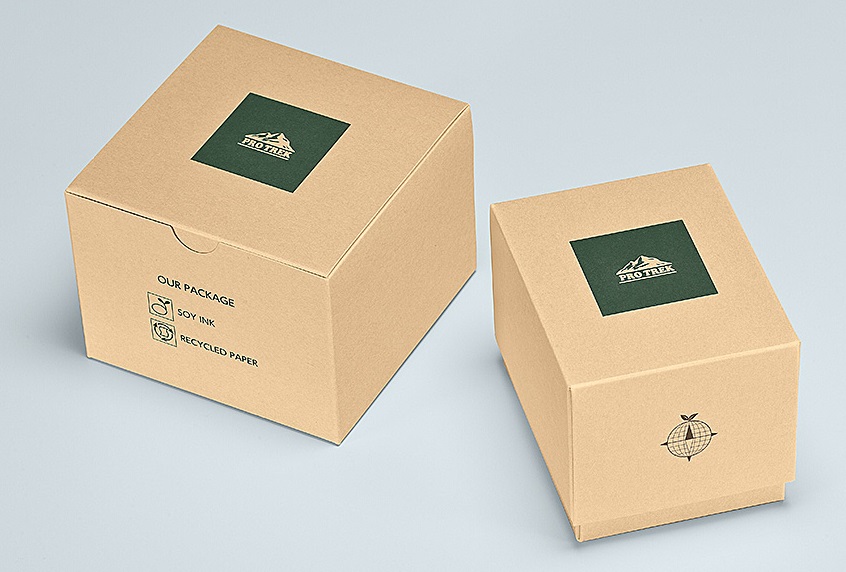
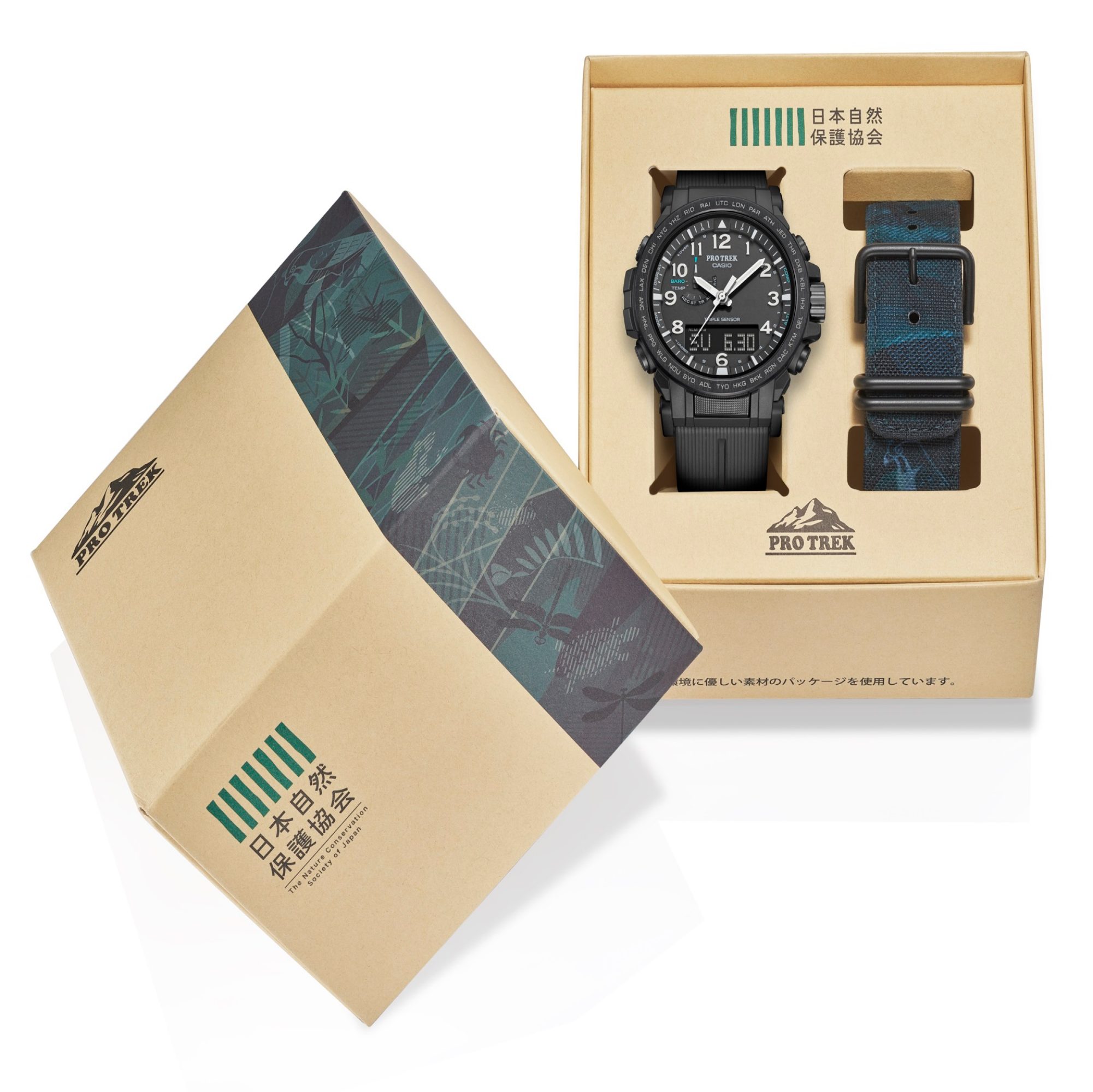
In addition to adopting packaging made from recycled paper, Casio uses inks made from plant-based raw materials which release fewer volatile organic compounds.
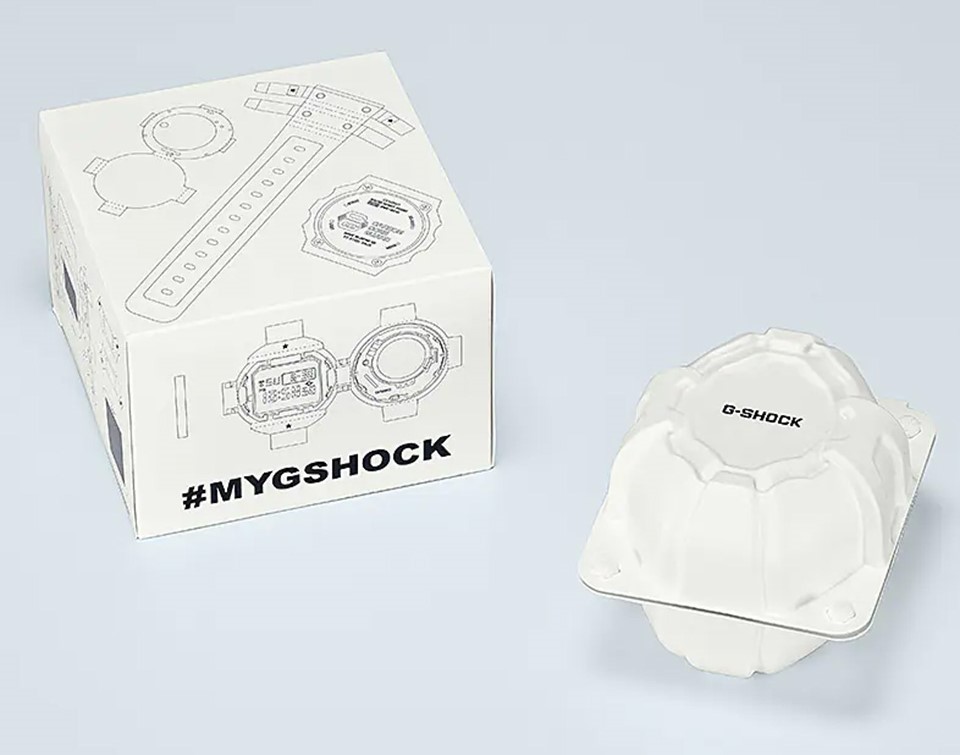
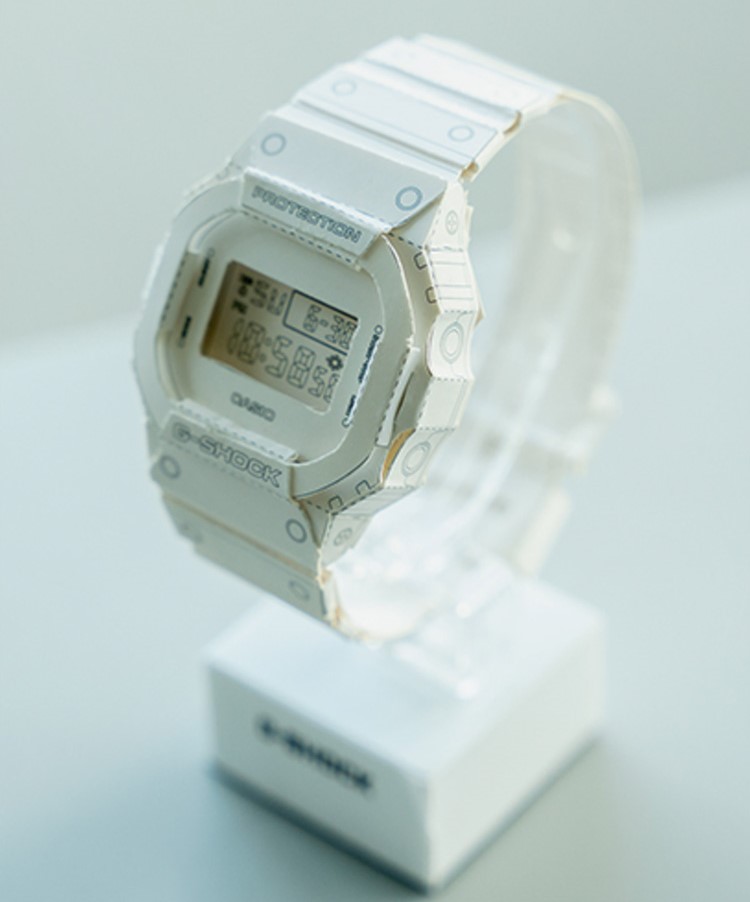
Initiatives in MY G-SHOCK
MY G-SHOCK, which lets customers create their own custom G-SHOCK by selecting parts, comes in plastic-free packaging with a paper outer box. The watch is held in a pulp-molded box.
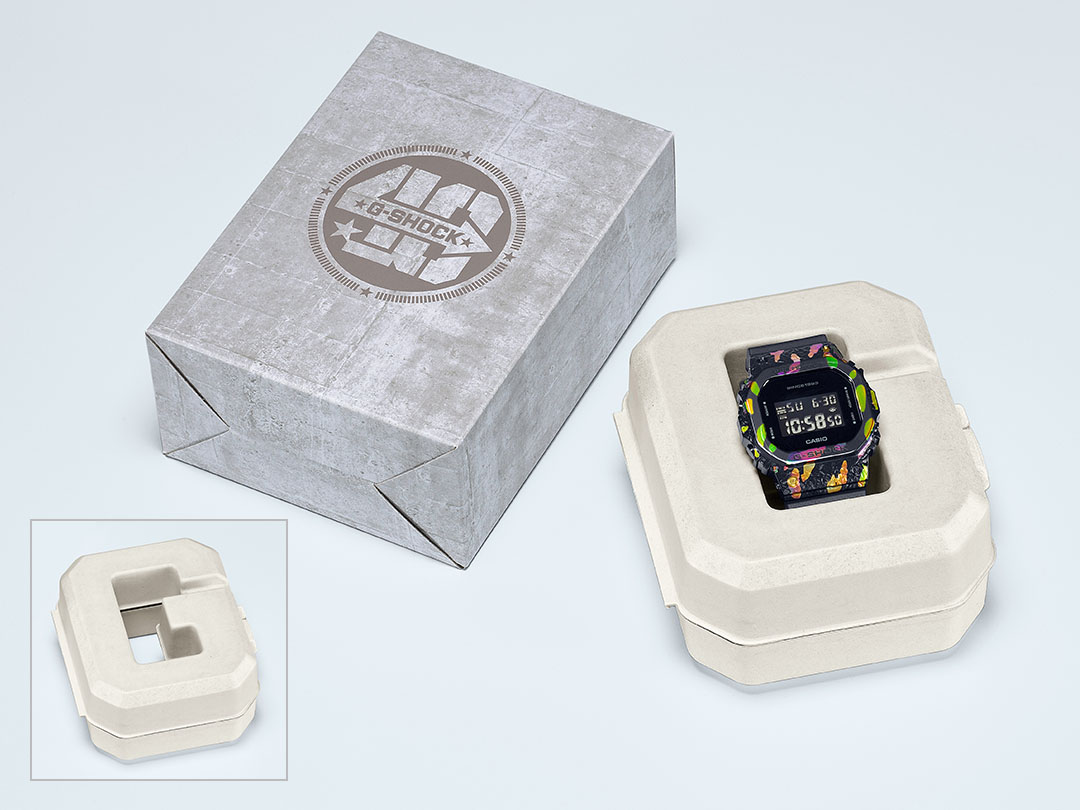
Initiatives in G-SHOCK 40th Anniversary Model “Adventurer’s Stone” Series
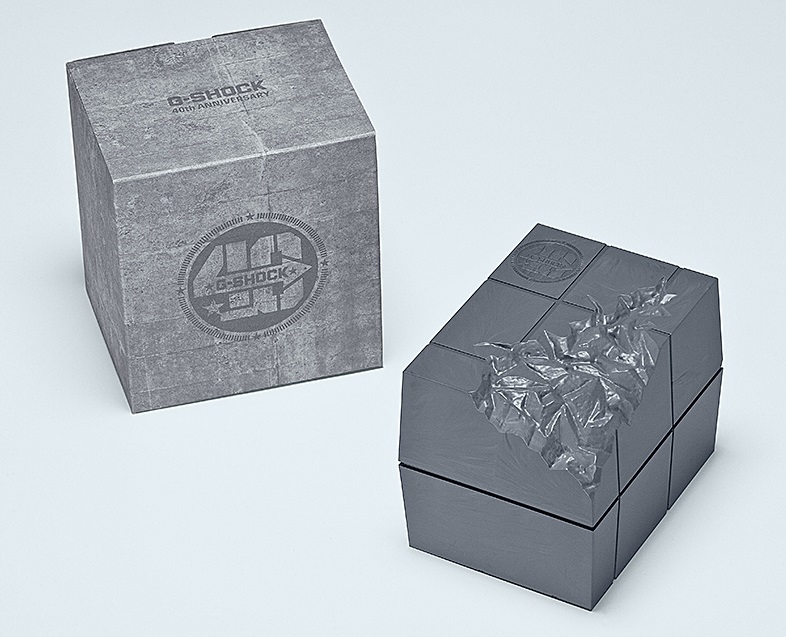
This 40th Anniversary G-SHOCK model use pulp-molded paper packaging. Casio also uses vegetable oil inks for the printing on the outer box.
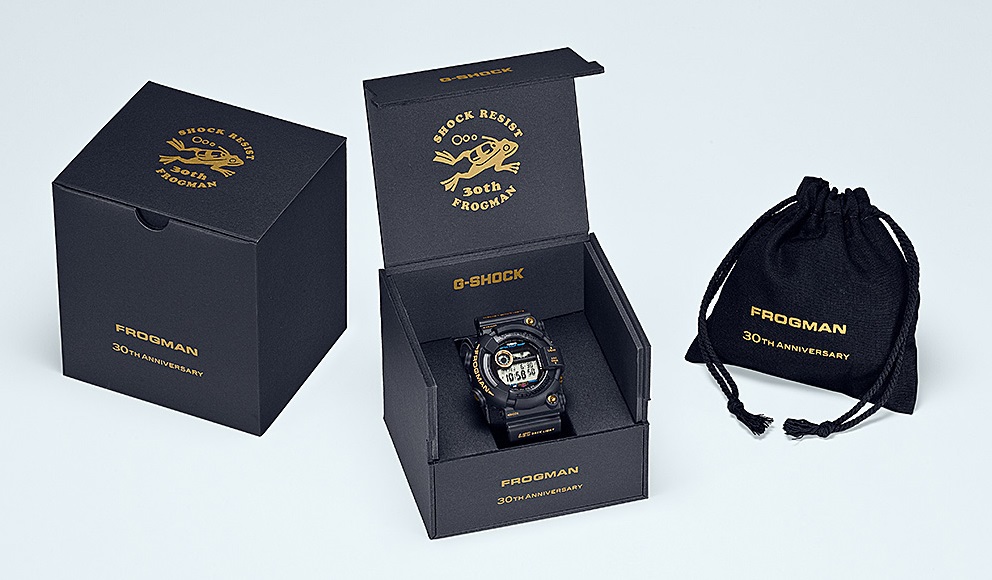
Initiatives in G-SHOCK FROGMAN 30th Anniversary Model
This model is made with biomass resin components, and comes in special packaging made from laminated paper board.
Initiatives in G-SHOCK 40th Anniversary Edition “Flare Red”
The outer box is made of recycled paper and printed on with plant-based inks which release few volatile organic compounds. The inner box is made from 100% recycled plastic.
Initiatives Related to Product Usage
Each watch model employs Casio original solar power system that reduces battery usage.
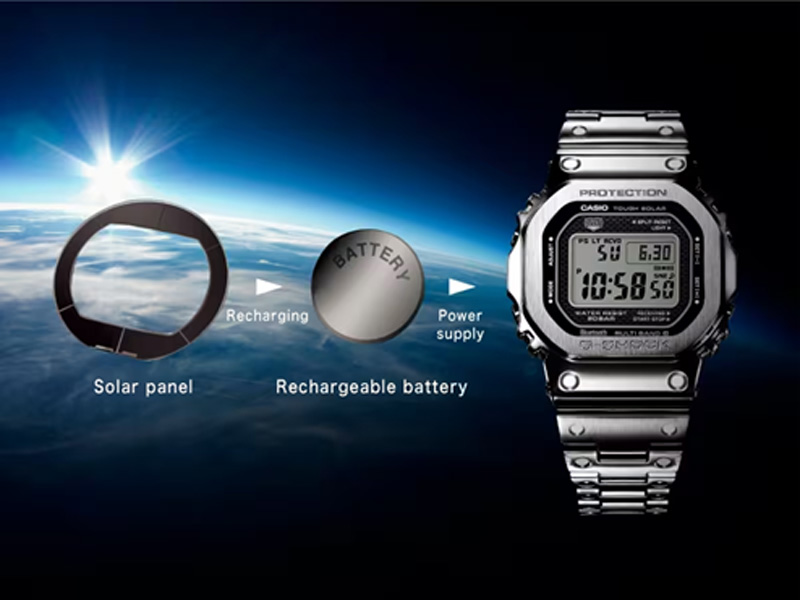
Tough Solar
This original Casio solar-charging system employs solar panels that convert light even from fluorescent lamps and other sources, combined with a rechargeable battery. Also includes a Power-Saving function that automatically engages when the watch is left for a certain period in a dark location.
Solar-Assisted Charging
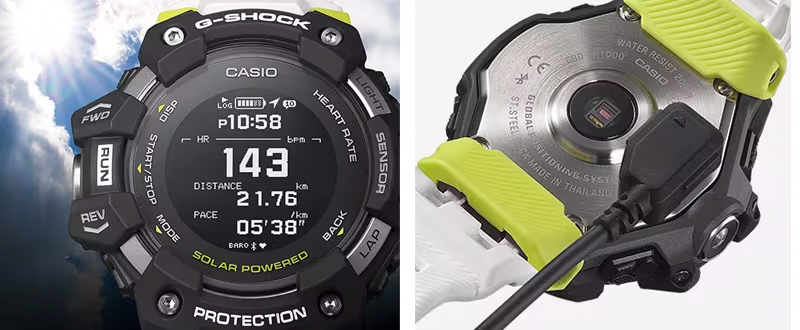
USB charging is used for power-intensive smart functions, while the time display is powered solely by solar charging.
Solar Charging
Time display is powered solely by solar charging, even when the battery runs low.
USB Charging
For training functions and smart functions, use a USB cable for charging.
Solar Charging System
Generates power from even faint light, such as from fluorescent lamps, reducing battery drain to allow extended use.

Casio is also pursuing Eco Mark certification and compliance with Japanʼs Act on Promoting Green Procurement, offering environmentally friendly products and contributing to a recycling-oriented society.