Biodiversity Preservation at Business Sites
Biodiversity Preservation at Business Sites
In 2017, Casio commissioned an expert outside agency (Ryokusei Research Institute Inc.) to conduct a biodiversity survey at the Group’s main sites in Japan. The results found that many species of insects and plants make their home at these sites. Rare species including Golden Orchid (Cephalantherafalcata), which is included on the Ministry of the Environment’s species Red List, and Silver Orchid (Cephalanthera erecta) and stalked adder’s-tongue(Ophioglossum petiolatum), both of which are on Tokyo’s Red List of threatened species, were found at the Hamura R&D Center in Hamura, Tokyo.
Members of the Hamura TC Protection Team, made up of employee volunteers, carry out observation and preservation activities for the year-round protection of the wildlife on the center’s premises. As a result of these observations, in spring 2023, new specimens of the Golden Orchid and Silver Orchid were confirmed, which had not been seen during the survey by outside experts. As part of the preservation activities, the team is working on measures to avoid the disappearance of rare plants, such as protecting them from pests and trying to increase their numbers on the premises through artificial pollination and seeding.
In addition, for three consecutive years in 2022, 2023 and 2024, Japanese sparrowhawks nested on the premises, and the center’s employees quietly watched over them until their chicks successfully left the nest.
Hamura R&D Center
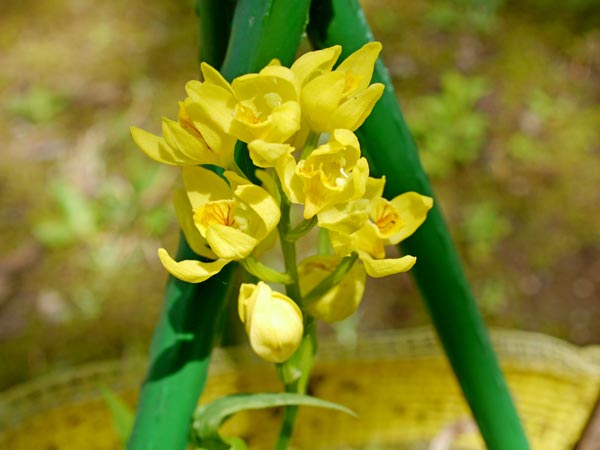
Golden Orchid (Cephalanthera falcata)
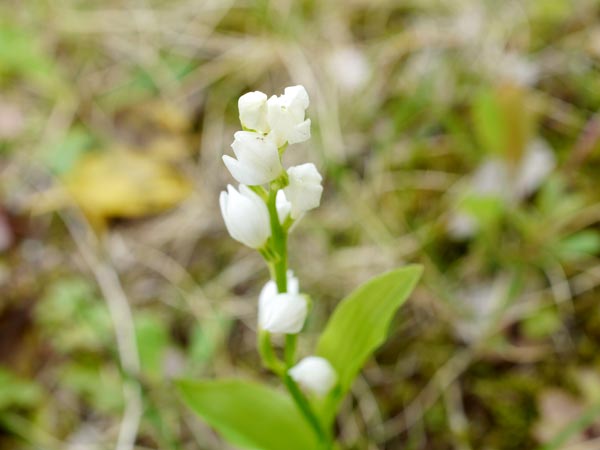
Newly discovered individual of Silver Orchid (Cephalanthera erecta)
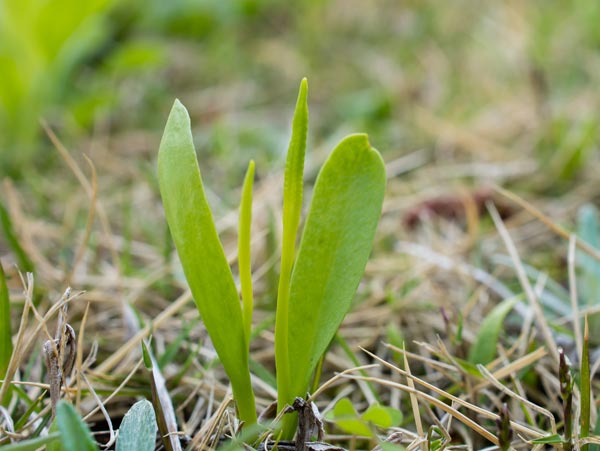
Adder's-tongue (Ophioglossum petiolatum)
Results of a survey of biodiversity at main business sites in Japan (Table 1)
| site | Number of species | Remarkable insects and plants | ||
|---|---|---|---|---|
| Insects | Plants | |||
| Casio Computer Co., Ltd. | Headquarters | 55 | 82 | |
| Hamura R&D Center | 105 | 187 | Plants: Golden Orchid, Silver Orchid, ophioglossum petiolatum | |
| Yamagata Casio Co., Ltd. | 82 | 173 | ||
| Casio Business Service Co., Ltd. (Kofu) | 82 | 160 | Plant: Rorippa cantoniensis | |

Biodiversity Preservation at Business Sites
Since the Golden Orchid and the Silver Orchid were found at the Hamura R&D Center in 2017, the Hamura TC Protection Team, a group of employee volunteers, has carried out conservation activities every year. The growth conditions above ground observed to date are summarized in the following table. Since 2021, the volunteers have also carried out artificial pollination and netting every year.
(Explanation of table)
Each individual is shown under the names K1 – K5 for the Golden Orchid and G1 – G5 for the Silver Orchid in the order in which they were found. The growth of each individual is indicated by the following symbols.
◎: Fruited, ●: Fruited after flowering, but seeds disappeared due to poor quality or pest damage,
▲: Growth stopped halfway - above-ground parts disappeared due to blight or pest damage, ✖: Did not germinate -: Not found
Golden Orchid
| FY | K1 | K2A | K2B | K3 | K4 | K5 |
|---|---|---|---|---|---|---|
| 2026 | ◎ | ✖ | ✖ | ◎ | ◎ | ◎ |
| 2025 | ◎ | ✖ | ✖ | ◎ | ◎ | ▲ |
| 2024 | ◎ | ✖ | ✖ | ◎ | ● | ● |
| 2023 | ◎ | ✖ | ✖ | ● | ― | ― |
| 2022 | ◎ | ✖ | ✖ | ● | ― | ― |
| 2021 | ◎ | ▲ | ▲ | ● | ― | ― |
| 2020 | ◎ | ▲ | ▲ | ◎ | ― | ― |
| 2019 | ◎ | ● | ● | ― | ― | ― |
| 2018 | ● | ● | ● | ― | ― | ― |
Golden Orchid
| FY | K1 | K2A | K2B | K3 | K4 | K5 |
|---|---|---|---|---|---|---|
| 2026 | ◎ | ✖ | ✖ | ◎ | ◎ | ◎ |
| 2025 | ◎ | ✖ | ✖ | ◎ | ◎ | ▲ |
| 2024 | ◎ | ✖ | ✖ | ◎ | ● | ● |
| 2023 | ◎ | ✖ | ✖ | ● | ― | ― |
| 2022 | ◎ | ✖ | ✖ | ● | ― | ― |
| 2021 | ◎ | ▲ | ▲ | ● | ― | ― |
| 2020 | ◎ | ▲ | ▲ | ◎ | ― | ― |
| 2019 | ◎ | ● | ● | ― | ― | ― |
| 2018 | ● | ● | ● | ― | ― | ― |
In addition, as a result of several years of observation, it has been empirically found that since plants such as Golden Orchid germinate in February before other plants, they are prone to damage by pill bugs. Once the growing point is damaged, the plant does not seem to grow above ground for the rest of the season. In addition, some plants have been damaged for two consecutive years, and the above-ground parts subsequently disappeared (the causal relationship is unknown). For this reason, when the germination season approaches, the center removes fallen leaves from the ground and also uses adhesive sheets for gardening purposes to prevent damage from pill bugs.
These conservation activities on the grounds are carried out every year by the Hamura TC Protection Team, a group of employee volunteers, based on the seasonal changes and growth conditions, as outlined below.
| Golden Orchids and Silver Orchids, etc. | Japanese sparrowhawks |
|---|---|---|
January | Seed storage |
|
February | Before germination: Start of observation, removal of fallen leaves, etc. |
|
March | Protection for damage from pill bugs, etc. |
|
April | Growth record (flowering, etc.), information shared internally |
|
May | Observation of ovary enlargement, vigilance | Start of observation of sparrowhawks nesting, information sharing internally Request for monitoring within the office |
June | Observation of ovary enlargement, vigilance | Continuous observation, information sharing internally |
July | Observation of ovary enlargement, vigilance | Continuous observation, information sharing internally |
August | Observation of ovary enlargement, vigilance | Leaving the nest / information sharing internally |
September | Observation of ovary enlargement, vigilance |
|
October | Observation of ovary enlargement, vigilance |
|
November | Seed collection, seed storage, information sharing internally |
|
December | Seed storage |
|
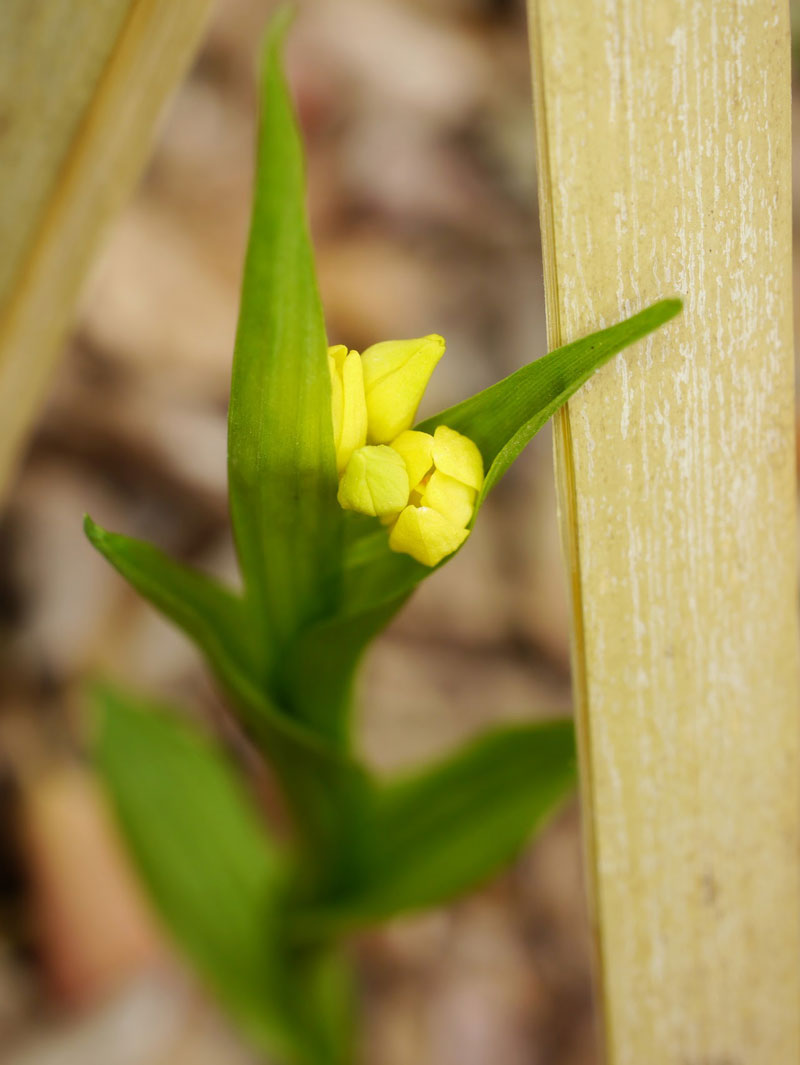
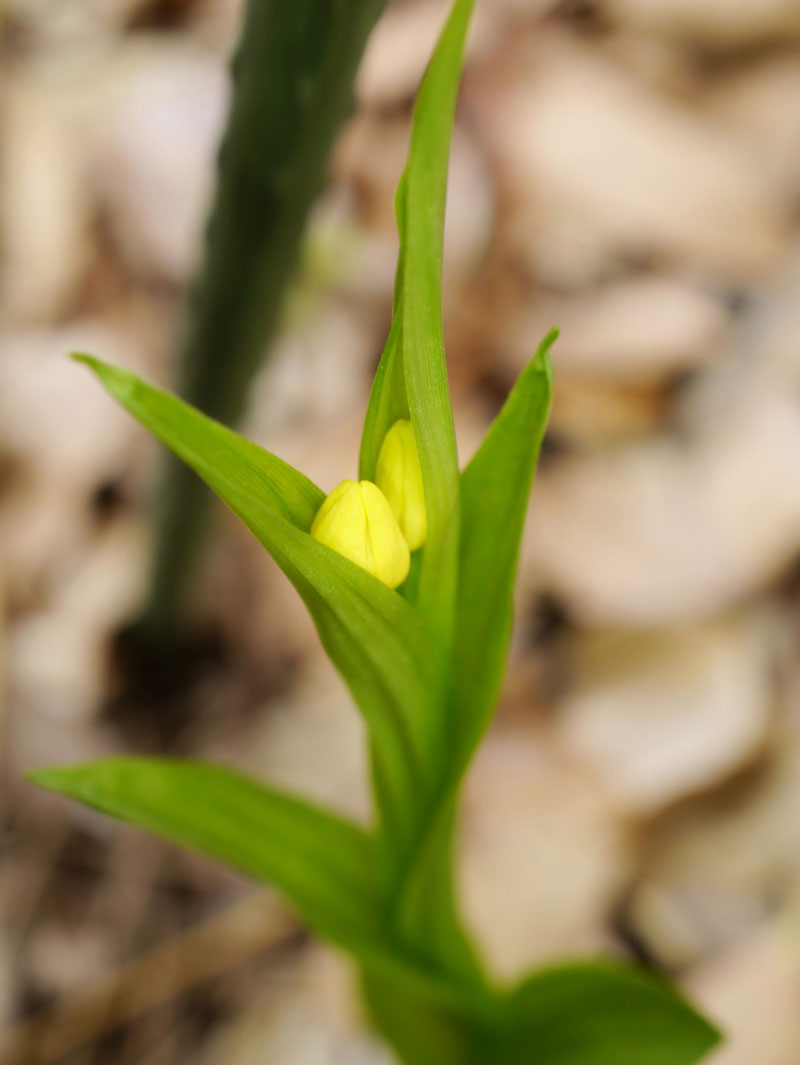
Golden Orchids found at the Hamura R&D Center on April 21,2023
At the Hamura R&D Center, reconstruction of the building is scheduled for the near future due to its aging. Therefore, in preparation for the eventuality that transplantation becomes necessary, the center referred to academic literature and planted young trees (Quercus serrata, Lithocarpus edulis) from species that can form a symbiotic relationship with the Golden Orchid, so that this orchid and these trees can be transplanted together. In addition, the Hamura TC Protection Team is making new improvements and refinements every year to avoid the effects of the orchid fly during the flowering season. At the end of the flowering season, artificial pollination is carried out to obtain seeds, and in 2024, the team began attempts to sow seeds using the “seed stick method,” with reference to academic literature.
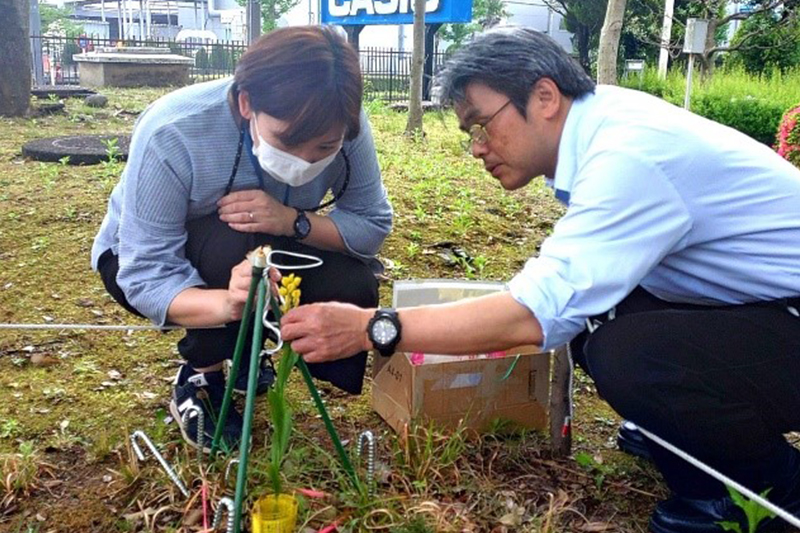
Artificial pollination by members of the Hamura TC Protection Team
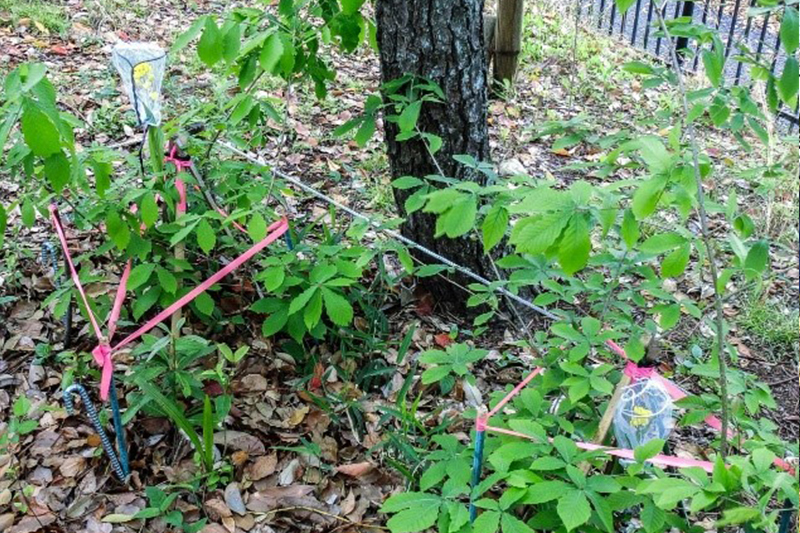
Two Golden Orchids after netting
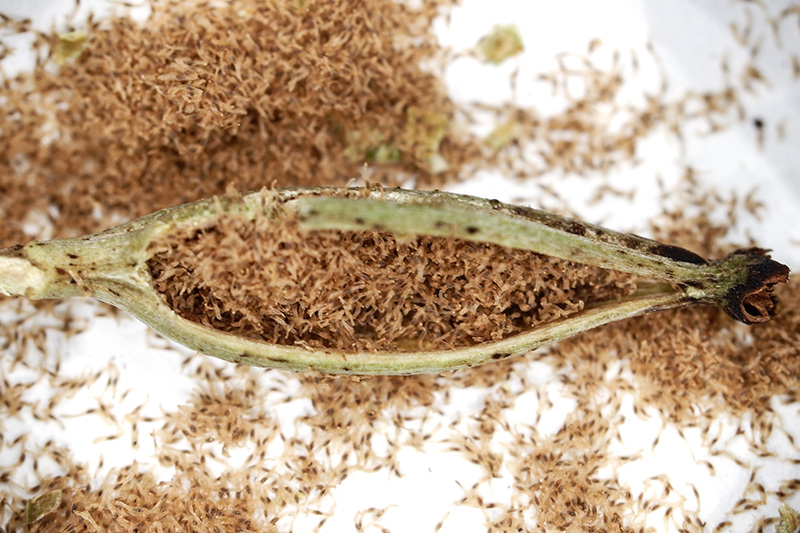
Ovary and seeds of the Golden Orchid
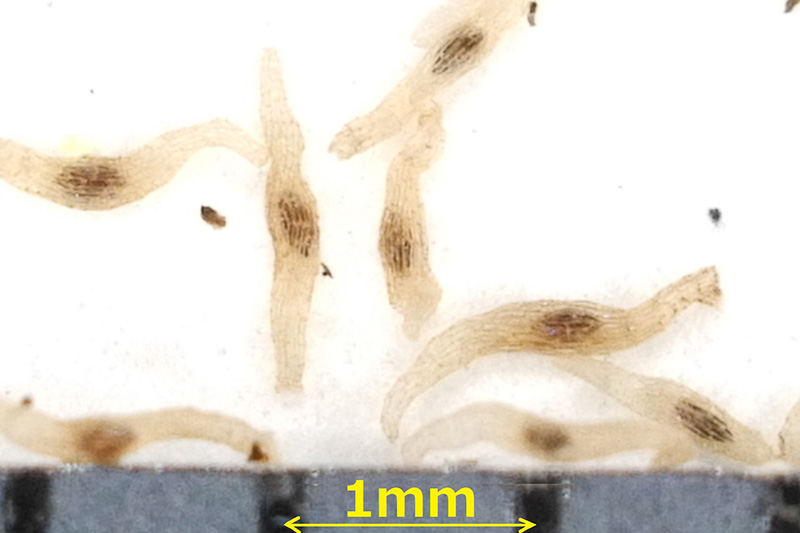
Enlarged photo of the seeds of the Golden Orchid
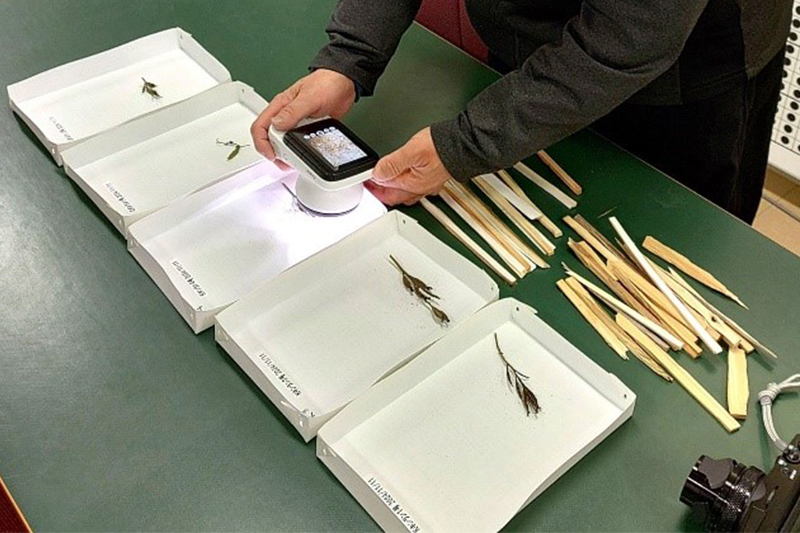
Making seed sticks
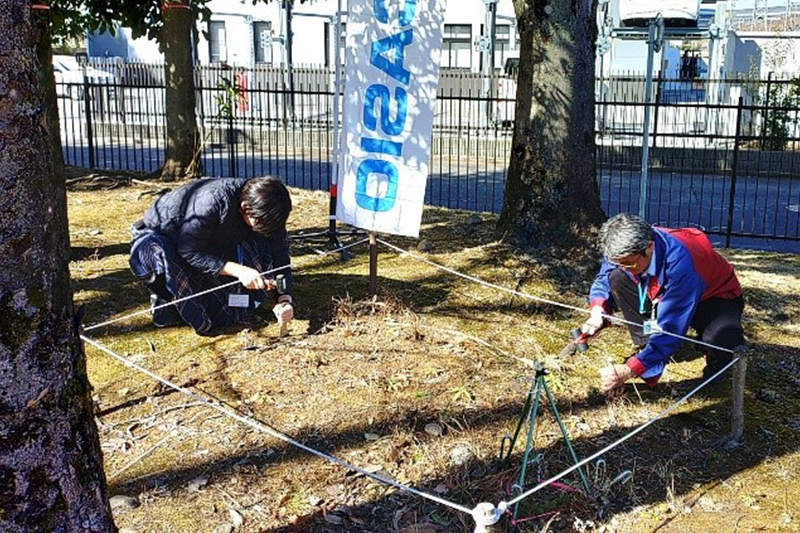
Sowing seeds (burying seed sticks)
At the Hamura R&D Center, in 2022 Japanese sparrowhawks, a bird of prey that is an endangered species, nested in a zelkova tree on the premises. The sparrowhawks had previously been observed nesting in Musashino Park to the west of the center, but it seems that the birds changed their nesting location to the center in 2022.
The following year, in 2023, Japanese sparrowhawks nested in the same zelkova tree on the premises, and their chicks hatched there for a second year. Furthermore, in 2024, the year after that, it was confirmed that the birds had nested and that the chicks had fledged in another zelkova tree on the premises. According to observations by the Hamura TC Protection Team, in 2024, after the chicks had fledged, it was confirmed that the same parent birds had nested a second time in the same nest.
In 2025, perhaps due to the impact from the commencement of reconstruction of the Hamura R&D Center, although the sparrowhawks were observed on the premises, it was not confirmed that they had nested. As chicks were confirmed in the neighboring Musashino Park, it was surmised that the birds had changed their nesting location. Although the causal relationship is unclear, the common kestrel, another small bird of prey, has started being seen on the premises.
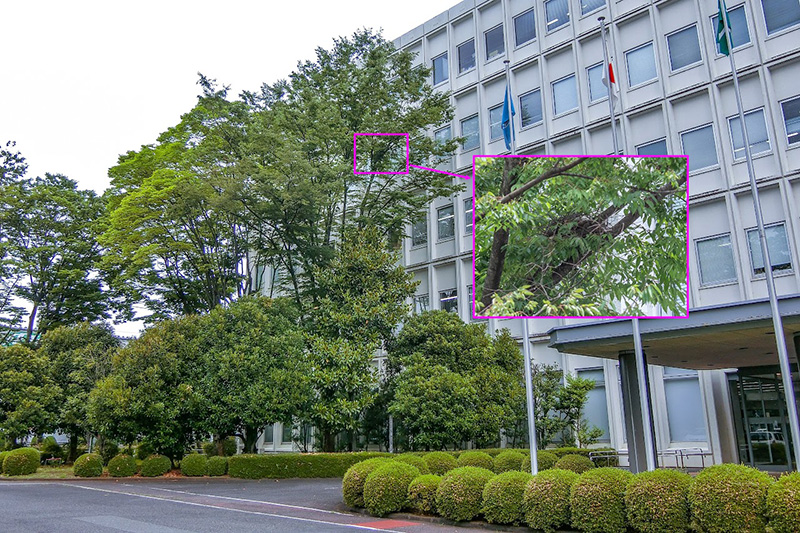
Location of the Japanese sparrowhawks’ nest in 2024
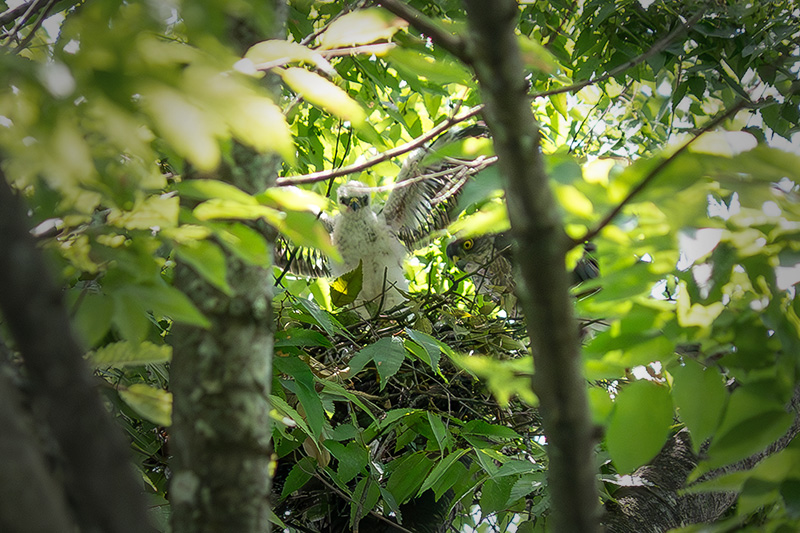
Japanese sparrowhawk chicks and their parents in 2024
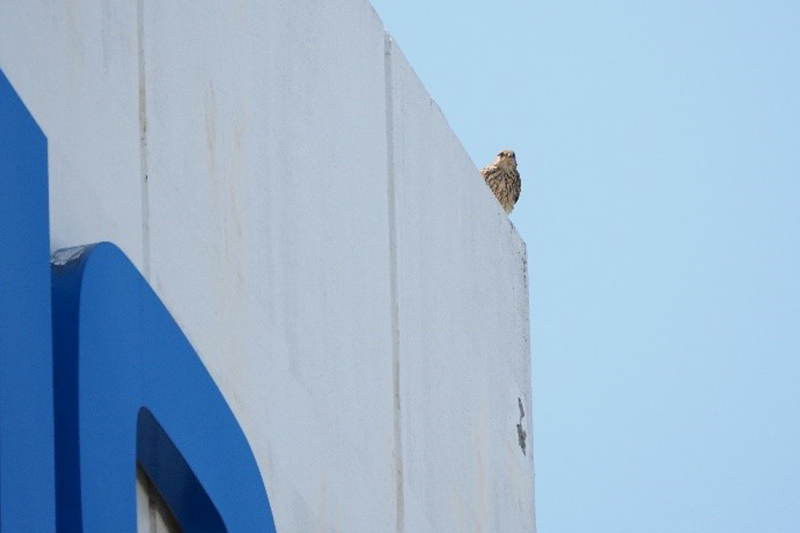
Common kestrel in 2025
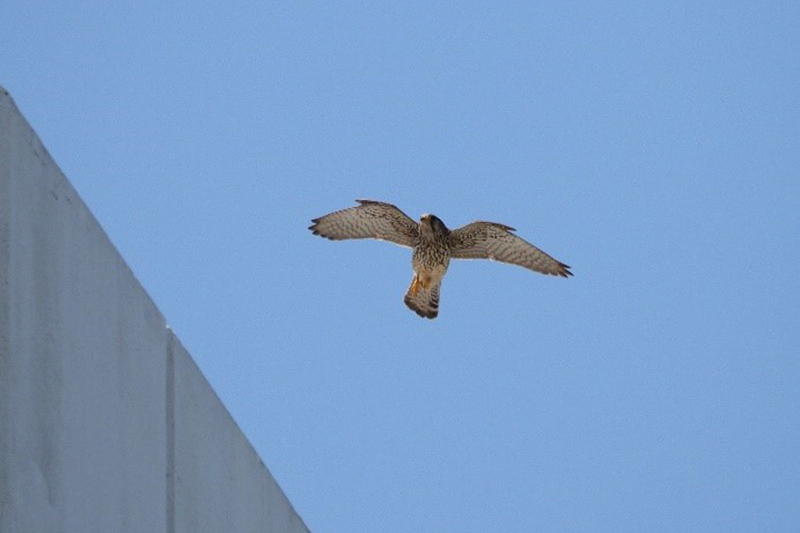
Common kestrel in 2025
*Updated on January 7, 2026